

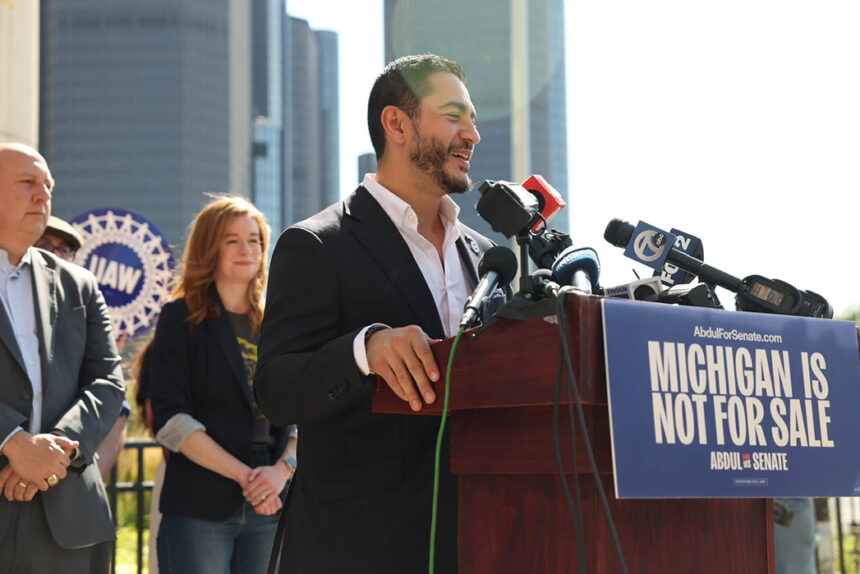
SAGINAW, Mich. — Abdul El-Sayed won Michigan.
He did not win Saginaw County.
For a candidate celebrating one of the biggest progressive victories of Michigan’s 2026 primary, that distinction is worth more than a passing glance.
El-Sayed narrowly defeated U.S. Rep. Haley Stevens in Tuesday’s Democratic primary for U.S. Senate, overcoming a major spending disadvantage and much of Michigan’s Democratic establishment.
Saginaw County went the other way.
A weakness visible before Election Day
The warning signs appeared before ballots were counted.
Polling during the final weeks of the campaign showed Stevens performing much better than El-Sayed among Black Democrats. One poll found Stevens leading El-Sayed 67% to 21% among Black voters. Stevens also held an advantage among older voters, while El-Sayed’s strength came largely from younger and more progressive Democrats.
Stevens made a deliberate effort to reach older Black voters through Black churches, community leaders and elected officials. El-Sayed had prominent Black supporters of his own and pointed to his years working in Detroit and Wayne County.
Election night showed the divide was real.
Stevens carried several Michigan counties with significant Black populations, including Saginaw, Genesee and Wayne. El-Sayed made up the difference with strong performances in places such as Washtenaw and Kent counties.
There is no exit poll showing that older Black voters alone cost El-Sayed Saginaw County, and the county’s electorate extends well beyond the city of Saginaw.
Still, the pattern is difficult to ignore.
El-Sayed struggled statewide with Black voters. He struggled with older voters. And he lost Saginaw County, where both groups matter.
That makes Saginaw less of an outlier and more of a warning.
Saginaw keeps picking winners
Saginaw County deserves special attention because it has developed an unusual political habit.
It keeps picking the winner.
In each of the last five presidential elections, Saginaw County backed the candidate who ultimately won the White House.
The county supported Barack Obama in 2008 and 2012, Donald Trump in 2016, Joe Biden in 2020 and Trump again in 2024.
The margins have sometimes been razor-thin. Biden carried Saginaw County by just 303 votes in 2020 before Trump flipped it back four years later.
That streak has helped give Saginaw a reputation as one of Michigan’s political bellwethers.
It is easy to see why.
The city of Saginaw has a substantial Black electorate and a long Democratic tradition. Outside the city, the landscape changes quickly, with working-class white voters, union families, suburban communities, agricultural areas and increasingly Republican townships.
Those groups live close enough to share workplaces, schools, hospitals and shopping centers while often arriving at Election Day with very different political views.
That mix looks a lot like Michigan.
The voters El-Sayed still needs
For El-Sayed, the Saginaw result raises a larger question about the coalition he will need against Republican Mike Rogers this fall.
Primaries reward enthusiasm. General elections demand addition.
El-Sayed proved he could win a Democratic primary by generating strong support among younger voters, progressives and voters frustrated with establishment politics.
November will require more.
He will need many of the voters who chose Stevens.
That includes Black Democrats who did not immediately connect with his campaign, older voters who preferred Stevens and working-class voters who may agree with parts of El-Sayed’s economic message without identifying with the progressive movement surrounding him.
Saginaw County contains all three.
Its recent political history also shows that those voters are willing to move.
Obama won the county twice. Trump broke through in 2016. Biden took it back by barely 300 votes. Trump reclaimed it four years later.
Those are not the voting patterns of a community permanently attached to one party.
They are the voting patterns of people willing to be persuaded.
A warning, not a prediction
Saginaw County is not a crystal ball.
Its importance is more practical than mystical.
Race and class meet here. So do urban and rural Michigan. Organized labor remains part of the political culture, but so does frustration with political institutions. There are loyal Democrats, committed Republicans and voters who have shown they are willing to cross party lines.
That is why El-Sayed’s loss here should matter to his campaign.
He does not need to become Haley Stevens or abandon the progressive voters who delivered his nomination.
But he does need to make sure Tuesday’s winning coalition does not become his ceiling.
The first job of a primary is to win your side.
The job after the primary is to make your side bigger.
Michigan chose Abdul El-Sayed.
Saginaw County did not.
For a county that has sided with the winner of five consecutive presidential elections, that is a result worth remembering when November arrives.